

Electrical
Aluminum Wiring: What Homeowners Need to Know About Safety, Insurance, and Repair
Why aluminum wiring was used, why its connections cause problems, how to tell if you have it, what Florida insurers require, and how AlumiConn and COPALUM repairs compare.
If your home was built in the late 1960s or early 1970s, there’s a real chance some of its wiring is aluminum instead of copper. For many Jacksonville homeowners, the first time they hear about it is when an insurance company asks for a 4-point inspection, or when an inspector flags it during a home sale.
Aluminum wiring isn’t an automatic emergency, and it doesn’t mean your house has to be torn apart. But it does need to be understood and, in most cases, properly repaired. This guide explains why it was used, where the real risk is, how to tell if you have it, what insurers are looking for, and how the two approved repair methods compare.
Why Aluminum Wire Was Used
In the mid-1960s, copper prices climbed sharply while home construction was booming. Aluminum conducts electricity well, was much cheaper, and was already widely used by utilities. Builders began using it for branch circuits, the wiring that runs to your outlets, switches, and light fixtures.
Most aluminum branch wiring in homes was installed between roughly 1965 and the mid-1970s. As problems emerged, builders switched back to copper, and by the late 1970s it had largely disappeared from new residential branch wiring.
Jacksonville grew quickly during those years. Many neighborhoods that expanded in the late ’60s and early ’70s, including large parts of Arlington, the Southside, Mandarin, and the Westside, have homes built squarely in the aluminum-wiring era. A build year in that window isn’t proof, but it’s a strong reason to check.
An Important Distinction: Not All Aluminum Wiring Is a Problem
When insurers and electricians talk about “aluminum wiring,” they almost always mean single-strand (solid) aluminum branch circuit wiring, the 15- and 20-amp circuits feeding outlets, switches, and lights.
Multi-strand aluminum is different. It’s still commonly and correctly used today for:
- The service entrance cables that bring power from the meter to your panel
- Large 240-volt circuits, such as feeds to AC units, ranges, or subpanels
When installed with properly rated equipment and torqued correctly, multi-strand aluminum is normal and accepted. The 4-point inspection form used in Florida lists these as separate categories for exactly that reason.
The Real Issue: Connections, Not the Wire
The aluminum wire inside your walls isn’t usually where the danger is. The problem is at the connection points: where the wire attaches to an outlet, switch, light fixture, or splice. The U.S. Consumer Product Safety Commission (CPSC) has reported that homes with older aluminum branch wiring are far more likely than copper-wired homes to have connections reach fire hazard conditions.
Several things combine to cause trouble at those connections:
1. Expansion and contraction. Aluminum expands and contracts more than copper or the brass screws on outlets and switches. Every time current flows, the connection warms up and swells slightly. When it cools, it shrinks. Over years of cycling, the screw terminal gradually loosens.
2. Creep (cold flow). Aluminum is a soft metal. Under the constant pressure of a screw terminal, it slowly deforms and flows away from the pressure point, which loosens the connection even further.
3. Oxidation. Aluminum forms an oxide layer on its surface almost immediately when exposed to air. Unlike copper oxide, aluminum oxide resists electricity. As a connection loosens and air gets in, that layer builds up and adds resistance.
4. Dissimilar metals. Where aluminum touches copper or brass, especially in Florida’s humidity, galvanic corrosion can occur at the contact point.
Why Movement Makes It Worse
Outlets and switches are the parts of your electrical system that get physically handled every day.
- Flipping a switch flexes the device slightly in its box, working the wire at the terminal back and forth.
- Plugging and unplugging pushes and pulls on the outlet, which shifts it and stresses the connection behind it.
- Heavy loads such as space heaters, hair dryers, window units, and vacuums heat the connection more, which speeds up the expansion and contraction cycle.
Each small movement loosens the connection a bit more. A loose connection creates resistance, resistance creates heat, and heat speeds up oxidation and loosening. This cycle can end with a connection hot enough to scorch the device, melt insulation, or ignite nearby materials, often without ever tripping the breaker.
“Backstab” connections, where the wire is pushed into a hole in the back of the device instead of wrapped around a screw, are especially prone to failure with aluminum.
Warning Signs to Take Seriously
- Outlet or switch cover plates that feel warm to the touch
- Flickering lights that aren’t caused by a bulb
- A smell of burning plastic near an outlet or switch
- Discolored or scorched outlets or switches
- Outlets or lights that stop working for no clear reason
- Buzzing or crackling sounds from a device
If you notice any of these, stop using that circuit, turn off its breaker, and call a licensed electrician.
How to Tell If Your Home Has Aluminum Wiring
Check the build year. Homes built or substantially wired between about 1965 and the mid-1970s are the most likely candidates. Your property record with the Duval County Property Appraiser lists the year built.
Look for markings on exposed cable. In the attic, garage, crawl space, or unfinished areas, look at the outer jacket of the wiring. Aluminum cable is typically printed with “AL” or “ALUMINUM” every few feet. Brand names from that era, such as Kaiser Aluminum, are also a clue. Copper-clad aluminum may be marked “CU-CLAD” or “Copper Clad AL.” It’s also treated as aluminum on the 4-point form.
Check your inspection reports. If you bought your home recently or have had a 4-point inspection, the wiring type should be noted on the report.
Look at the wire color at a device (carefully). Aluminum conductors are silver-colored rather than copper-colored. The safest way to confirm this is to let an electrician open a device or the panel. Please don’t remove outlet covers or open your panel yourself unless the power is off and you’re comfortable doing it safely.
Have it professionally inspected. An electrician can confirm the wiring type, check its condition, and count the connection points that will need attention. That count is what drives the cost of any repair.
Aluminum Wiring and Home Insurance in Florida
For Florida homeowners, insurance is usually what turns aluminum wiring from “something to look into” into “something that needs to happen before renewal.”
The 4-Point Inspection
Most Florida insurers require a 4-point inspection on older homes before writing or renewing a policy. It covers the roof, electrical, plumbing, and HVAC. The age at which it’s required varies by carrier. Citizens Property Insurance, the state-backed insurer of last resort, requires one on homes 20 years and older, and many private carriers set similar thresholds.
The electrical section of the current Citizens 4-point form asks the inspector to identify:
- The wiring type, with single-strand aluminum and multi-strand aluminum listed separately
- Whether aluminum connections have been repaired via COPALUM crimp or repaired via AlumiConn
- Hazards such as scorching, loose wiring, double taps, and improper breaker sizes
Those two repair methods are named directly on the form. That tells you a lot about which repairs the insurance industry recognizes.
What Insurers Are Looking For Today
Florida’s insurance market has tightened considerably in recent years, and aluminum wiring is one of the most common electrical reasons for a declined application or a non-renewal. Here’s what to expect:
- Unrepaired single-strand aluminum branch wiring will get a decline or non-renewal from essentially every standard Florida carrier.
- Repaired with COPALUM or AlumiConn: Some carriers, including Citizens and several private insurers, will write the policy. Many carriers will not accept connector repairs at all and require a full copper rewire. Guidelines change often, so check with your agent before choosing a repair method.
- Standard wire nuts and “pigtailing” with ordinary connectors are not accepted. That includes the purple twist-on connectors sold for aluminum-to-copper use.
- Documentation matters as much as the work itself. Insurers typically want a written certification from a licensed electrician stating the method used and confirming every connection point was addressed. Permits and inspections should be closed out. A re-inspection is usually needed afterward.
Buying or Selling a Home
If you’re buying a home in the Jacksonville area built in that era, schedule the 4-point inspection early. You’ll need an insurance policy bound to close, and you don’t want to discover aluminum wiring a few days before closing. Remediation usually has to be scheduled, permitted, and inspected, so build that time into your contract.
If you’re selling, handling the repair and documentation ahead of time removes one of the most common obstacles for buyers.
Remediation Options: How They Work, Pros and Cons
The goal of remediation is simple: get the aluminum out of the connection points that fail. Both approved connector methods attach a short copper “pigtail” to the aluminum wire using a connector designed specifically for aluminum. The copper pigtail then connects to the outlet, switch, or fixture. The aluminum stays in the wall, but it no longer touches the devices you handle every day.
This has to be done at every connection point in the house: every outlet, switch, light fixture, ceiling fan, hardwired appliance, and junction box, including the ones hidden in the attic.
Copper & Co. performs both AlumiConn and COPALUM repairs, so we can recommend the right method for your home, your budget, and your insurance carrier.
COPALUM Crimp Connectors
How it works: COPALUM uses a special crimp sleeve and a proprietary compression tool. The tool applies several tons of force and permanently fuses the aluminum and copper wires inside the sleeve in a “cold weld.” The connection is sealed in an insulating sleeve, leaving no screw and no air gap.
Pros:
- Widely regarded, including by the CPSC, as the most permanent repair short of a full rewire
- No screws or moving parts that can loosen over time
- The connection is gas-tight, which prevents oxidation
- Long history and a strong reputation with insurers and inspectors
Cons:
- Must be installed by electricians trained and equipped with the proprietary tooling, which limits availability
- Usually costs more than AlumiConn
- Needs enough wire length in the box to make the crimp
- Once crimped, it can’t be undone. If a pigtail needs to change later, it’s cut and redone.
AlumiConn Connectors
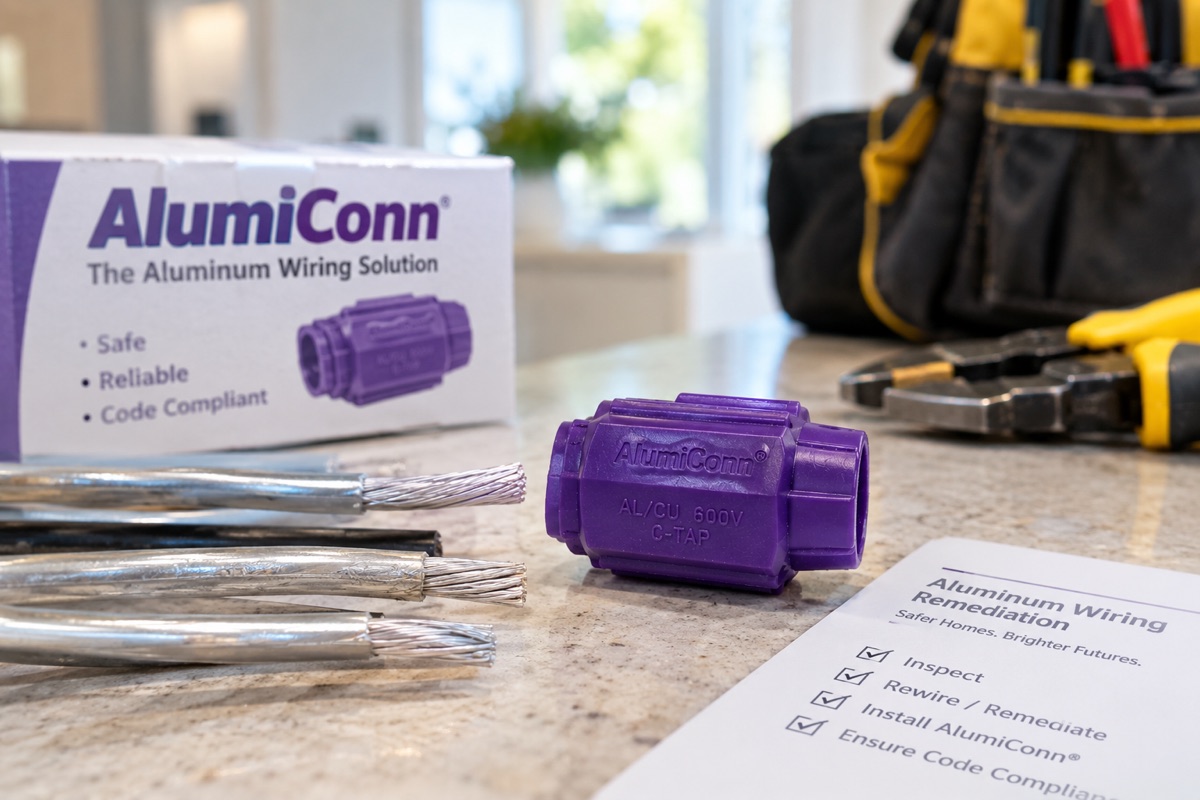
How it works: AlumiConn is a small purple lug connector with separate ports for each wire. Each wire gets its own set screw, which is tightened to a specified torque with a calibrated torque screwdriver. The connector body is pre-filled with a sealant that keeps air and moisture away from the connection.
Pros:
- UL-listed for aluminum-to-copper connections and recognized by the CPSC as an acceptable repair
- Doesn’t require proprietary crimp tooling, so it’s more widely available
- Generally less expensive than COPALUM
- Compact, which helps in crowded boxes
- Can be inspected and serviced later if needed
Cons:
- Performance depends on correct installation. Each set screw must be torqued to spec, which is why who installs it matters.
- It’s a mechanical, screw-based connection, not a permanent cold weld
- Some insurers and inspectors have a stated preference for COPALUM
- Slightly bulkier than a standard wire nut, which can matter in small or crowded boxes
Full Copper Rewire
Replacing all aluminum branch wiring with copper is the most complete fix, and it’s accepted by every insurer. It’s also the most expensive and disruptive option, usually requiring access through walls and ceilings. It makes the most sense during a major renovation, when walls are already open, or when your preferred carrier won’t accept connector repairs.
Other Approaches (and Why We Don’t Rely on Them)
- CO/ALR outlets and switches are rated for direct aluminum connection. They’re better than standard devices, but they only address outlets and switches, not fixtures and splices, and they’re not the repair insurers are looking for.
- Twist-on connectors marketed for aluminum aren’t considered a reliable long-term repair and aren’t accepted for insurance purposes.
Quick Comparison
| COPALUM | AlumiConn | Full Rewire | |
|---|---|---|---|
| Connection type | Permanent crimp (cold weld) | Torqued set screw lug | All-copper wiring |
| Permanence | Highest among connector repairs | High when correctly torqued | Complete |
| Installer requirements | Trained installer with proprietary tool | Licensed electrician with torque tools | Licensed electrician |
| Relative cost | $$ | $ | $$$ |
| Disruption | Low (work through device boxes) | Low (work through device boxes) | High (wall and ceiling access) |
| Listed on Citizens 4-point form | Yes | Yes | N/A (becomes copper) |
How to Tell If Aluminum Wiring Has Already Been Repaired
If you bought a home and the seller says the aluminum wiring “was taken care of,” here’s how to verify it.
1. Ask for the paperwork. A proper repair should come with a written certification from the electrician stating the method used and that all connection points were addressed. Also look for a closed permit. For homes inside the city, you can check City of Jacksonville permit records. The Beaches cities and surrounding counties keep their own records.
2. Look inside a few devices (with the power off, or have us do it). Behind the outlet or switch, you should see:
- Copper pigtails connecting to the device, not silver aluminum wire
- AlumiConn: a small purple connector body with set screws
- COPALUM: a compact crimped sleeve, usually covered with an insulating sleeve, joining the aluminum and copper wires
3. Watch for red flags:
- Aluminum wire still connected directly to outlets or switches
- Ordinary wire nuts (or purple twist-on connectors) joining aluminum to copper
- Some devices repaired and others not, which is common with partial or DIY jobs
- Light fixtures, fans, or attic junction boxes that were skipped
- No documentation at all
4. Get it verified. Insurers will rely on the 4-point inspection and your documentation. If you’re not sure the previous work was complete, an electrician can spot-check or fully verify it and provide the certification your carrier needs.
The Bottom Line
Aluminum wiring was a reasonable choice for builders in the 1960s and ’70s, but decades later its connection points are a known weak spot. In Florida, it’s also one of the fastest ways to run into trouble with a home insurance policy. The good news is that it’s a well-understood, fixable problem. With COPALUM or AlumiConn repairs, or a full rewire when needed, your home can be safer and insurable again, usually without opening up your walls.
This article is for general information only. Insurance underwriting guidelines change frequently and vary by carrier. Confirm current requirements with your insurance agent before choosing a repair method. Always hire a licensed electrician for electrical work.
Frequently asked questions
Is aluminum wiring illegal?
No. It isn't illegal to have aluminum wiring in your home, and homes with it can be bought and sold. The issues are safety at the connection points and insurability.
Is my house going to catch fire?
Not necessarily, but unrepaired aluminum branch wiring carries a well-documented, higher risk of connection overheating. Repair reduces that risk significantly.
Can I just replace my outlets and switches?
Replacing devices alone doesn't fix the problem unless the connections are properly remediated. Standard devices aren't rated for aluminum, and every splice and fixture connection also needs attention.
Can I do the repair myself?
We strongly advise against it. The work involves every connection in the house, needs specialized tools and torque specs, and insurers require certification by a licensed electrician.
How long does remediation take?
Most connector repairs in an average-sized home take one to a few days, depending on the number of connection points. A full rewire takes longer.
Which method should I choose?
Start with your insurance carrier's requirements, then weigh budget and permanence. We'll walk through the options with you and your agent.
Does multi-strand aluminum on my AC or service entrance need to be replaced?
Usually not. Multi-strand aluminum on large circuits is normal. It should be installed with rated terminals and checked for proper torque periodically.