

A/C
What's Wrong With My AC? Common Air Conditioning Problems and How They're Fixed
Warm air, water leaks, frozen lines, strange noises, high bills: what causes the most common AC problems in Jacksonville homes and how a technician fixes them.
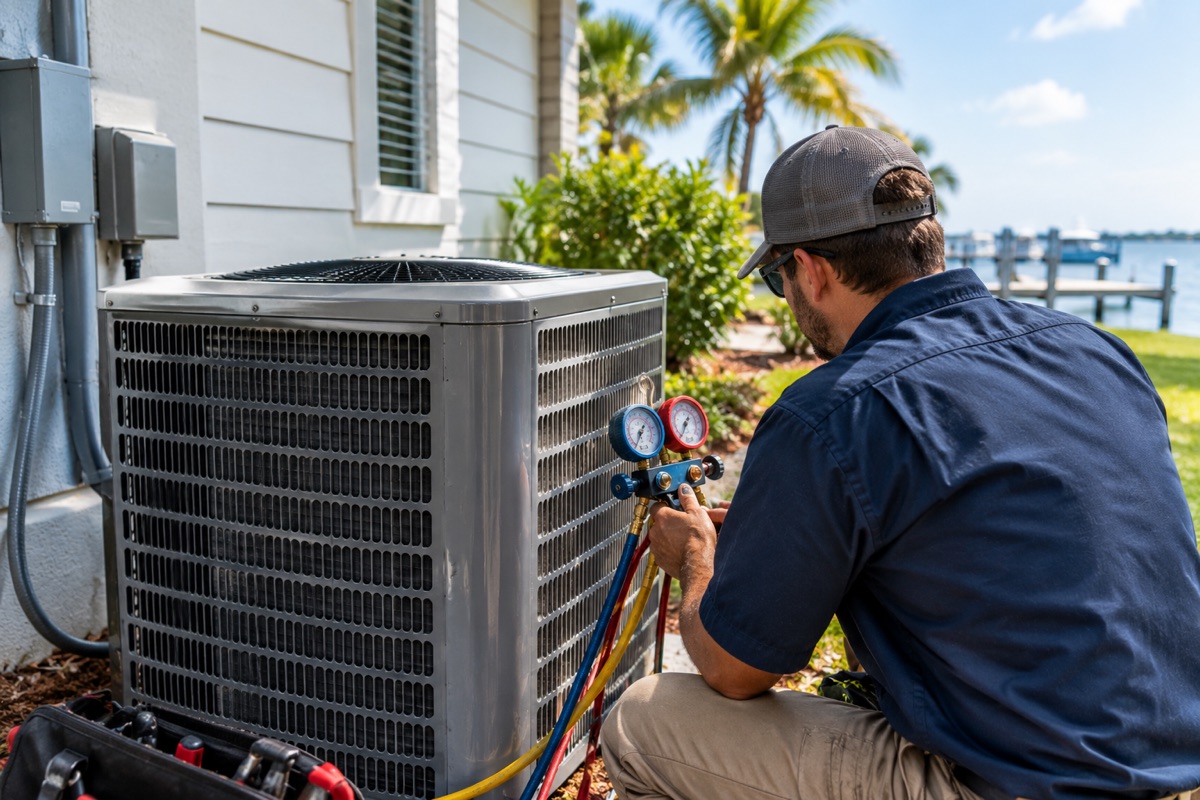
In Jacksonville, your air conditioner isn’t a summer appliance. It’s a year-round workhorse. Between long, humid summers and mild winters, most local systems run far more hours than systems up north, and that shows up in how and when they need attention.
The good news is that most AC problems give you some warning, and most of them are straightforward to fix. This guide walks through the symptoms homeowners notice most often, what usually causes them, and what a technician does to set things right, so you know what to expect when you call.
Quick Reference: Symptoms, Causes, and Fixes
| What you notice | Most common causes | Typical fix |
|---|---|---|
| Air isn’t as cool as it should be | Low refrigerant, dirty outdoor coil, failing capacitor or fan motor | Leak repair and recharge, coil cleaning, part replacement |
| AC runs nonstop and can’t keep up | Dirty coils, low refrigerant, leaky ducts, undersized system | Cleaning, leak repair, duct sealing, load calculation |
| AC turns on and off frequently | Oversized system, low refrigerant, thermostat placement | Refrigerant correction, thermostat relocation, proper sizing |
| Water around the indoor unit | Clogged condensate drain, rusted drain pan, tripped float switch | Drain clearing and treatment, pan replacement |
| Ice on the lines or indoor coil | Airflow restriction, low refrigerant, blower issue | Thaw, diagnose airflow, repair leak or blower |
| Outdoor unit hums but the fan doesn’t spin | Failed capacitor, worn contactor, fan motor | Replace the failed component |
| House feels sticky even when it’s cool | Oversized system, fan settings, high airflow | Airflow adjustment, whole-home dehumidifier |
| Some rooms much warmer than others | Duct design, leaky or crushed ducts, attic heat | Duct repair or redesign, balancing, zoning |
| Power bills creeping up | Dirty coils, low charge, aging equipment | Service and repair, or efficiency upgrade |
| Thermostat is blank or AC won’t start | Tripped breaker or float switch, blown control fuse, bad transformer | Electrical diagnosis and repair |
Now for the details.
1. The Air Isn’t as Cool as It Used to Be
This is the most common call we get. The system runs and air comes out of the vents, but it’s lukewarm or just not as crisp as it used to be.
What’s usually behind it:
- Low refrigerant. Your AC doesn’t “use up” refrigerant. If it’s low, there’s a leak somewhere, often at a joint, a valve, or in the indoor coil. Topping it off without finding the leak only buys time.
- A dirty outdoor coil. The outdoor unit’s job is to get rid of heat. When its coil is caked with dirt, pollen, grass clippings, or oak debris, it can’t shed heat efficiently, and cooling suffers. Jacksonville’s spring pollen season is especially hard on these coils.
- A weak capacitor or fan motor. If the outdoor fan or compressor isn’t getting a proper start, the system can run without really cooling.
How it’s fixed: A technician checks refrigerant pressures and temperatures to see whether the charge is correct, then locates and repairs any leak before recharging. Coils are cleaned, and electrical components like capacitors are tested under load and replaced if they’re out of spec.
Worth knowing: Older systems that use R-22 refrigerant are expensive to recharge because R-22 is no longer produced. New systems installed today use newer refrigerants such as R-454B or R-32. If your system is an older R-22 unit with a significant leak, that’s often the point where a new, right-sized system makes more financial sense than repair.
2. The AC Runs All Day and Can’t Keep Up
On a 95-degree August afternoon with high humidity, it’s normal for your AC to run long cycles. Most systems are designed to hold a comfortable indoor temperature under typical local conditions, not to get your home to 68 degrees at 4 p.m. during a heat wave. If the house stays around your set temperature and catches up in the evening, the system may be doing exactly what it’s designed to do.
It’s worth a service call when the system runs constantly and still drifts several degrees above the setpoint, or when it’s struggling on milder days too.
What’s usually behind it:
- Dirty indoor or outdoor coils
- Low refrigerant from a leak
- Leaky or disconnected ductwork. In most Jacksonville homes, ducts run through the attic, where summer temperatures can climb well past 130 degrees. A leak there dumps your cooled air into the attic and pulls hot attic air into the system.
- An undersized system, or an older system that has lost capacity over time
- Poor attic insulation or ventilation adding heat load to the house
How it’s fixed: Cleaning and refrigerant correction solve a lot of cases. Duct problems are found by inspection and sometimes by pressure testing, then sealed or repaired. If the system is truly undersized, a proper load calculation (called a Manual J) tells you what size your home actually needs before any replacement. Every new A/C system quote we give starts with one.
3. The AC Turns On and Off Too Often
This is called short cycling. The system starts, runs for a few minutes, shuts off, and starts again. Short cycling is hard on the compressor, wastes energy, and leaves your home clammy because the system never runs long enough to pull moisture out of the air.
What’s usually behind it:
- An oversized system. Bigger isn’t better in Florida. An oversized unit cools the air quickly and shuts off before it has removed much humidity.
- Low refrigerant or a frozen coil
- A thermostat in a poor location, like next to a supply vent, in direct sun, or near a kitchen
- A failing electrical component or safety switch
How it’s fixed: A technician checks the refrigerant charge, safety controls, and electrical components first. Thermostats can be relocated. If the system is oversized, adjusting fan speeds can help, and when it’s time to replace, choosing a correctly sized or variable-speed system solves it for good.
4. Water Around the Indoor Unit
Your AC removes a lot of moisture from the air. On a humid Jacksonville day, a typical home system can pull gallons of water out of the air. That water drains through a condensate line, usually to the outside or into a plumbing drain.
What’s usually behind it:
- A clogged condensate drain line. Our warm, humid climate is ideal for algae and slime growth inside drain lines. This is one of the most common summer service calls in Northeast Florida.
- A rusted or cracked drain pan, especially on older systems
- A tripped float (safety) switch. Many systems have a switch that shuts the AC off when water backs up. If your AC suddenly stops and there’s water in the pan, the switch is doing its job and protecting your ceiling and floors.
- A disconnected drain line or a failing condensate pump
How it’s fixed: The drain line is cleared and flushed, and often treated to slow algae regrowth. Damaged pans are replaced. Where there’s no float switch, adding one is an inexpensive way to prevent water damage down the road.
If your indoor unit is in the attic, a water stain on the ceiling below it is often the first clue. It’s worth having it looked at promptly, before the water finds its way into drywall.
5. Ice on the Refrigerant Lines or Indoor Coil
It seems odd for an AC to freeze in Florida, but it happens. Ice forms when the indoor coil gets too cold, usually because not enough warm air is moving across it.
What’s usually behind it:
- Restricted airflow from a severely clogged filter, closed or blocked vents, or a dirty indoor coil
- Low refrigerant, which drops coil temperature below freezing
- A blower motor problem, where the indoor fan isn’t moving enough air
How it’s fixed: The system has to fully thaw before it can be properly diagnosed. Turning the cooling off and letting the fan run speeds that up. From there, the technician checks airflow, the blower, and refrigerant levels, and repairs whichever is responsible. Running a frozen system can stress the compressor, so it’s best to shut cooling off once you notice ice.
6. The Outdoor Unit Hums, but the Fan Isn’t Spinning
You hear a hum or buzz from the outdoor unit, but the fan on top is still, or the unit tries to start and stops.
What’s usually behind it:
- A failed capacitor. Capacitors give the compressor and fan motor the extra push they need to start. Heat is hard on them, so they’re one of the most common summer failures in Jacksonville.
- A worn contactor, the electrical switch that turns the outdoor unit on and off. Its contacts can pit and burn over time. Occasionally one sticks closed, which leaves the outdoor unit running even when the thermostat says it should be off.
- A failing fan motor
How it’s fixed: These are usually quick and relatively affordable repairs. The technician tests the components and replaces what’s failed. Addressing this promptly matters, because a compressor that keeps trying to start without its capacitor can overheat.
7. The House Feels Sticky, Even When the Thermostat Says It’s Cool
In Jacksonville, comfort is as much about humidity as temperature. A home at 75 degrees and 65 percent humidity feels worse than one at 77 degrees and 50 percent.
What’s usually behind it:
- An oversized system that short cycles and doesn’t run long enough to dehumidify
- The thermostat fan set to “On” instead of “Auto.” With the fan running constantly, moisture sitting on the indoor coil can be blown back into the house between cooling cycles.
- Airflow set too high for our climate
- Leaky ducts pulling in humid attic or garage air
How it’s fixed: A technician can adjust blower speed and settings to improve moisture removal. Duct leaks can be sealed. For homes that still struggle, a whole-home dehumidifier works alongside your AC to keep humidity in a comfortable, healthy range. Keeping indoor humidity in check also helps prevent musty odors and mold growth.
8. Some Rooms Are Much Warmer Than Others
A bonus room over the garage that’s always hot, a back bedroom that never cools down, or an upstairs that runs several degrees warmer than downstairs are common complaints, especially in two-story homes.
What’s usually behind it:
- Duct runs that are too small, too long, or poorly designed for those rooms
- Crushed, kinked, or disconnected ducts in the attic
- Rooms with more sun exposure or less insulation
- One system trying to serve two very different floors
How it’s fixed: Options range from repairing and balancing the existing ducts, to adding or resizing duct runs, to installing a zoning system or a ductless mini-split for a problem room. A good technician will start by finding out why the room is warm before recommending equipment.
9. Noises and Smells You Haven’t Noticed Before
Your AC will always make some noise, but a new sound is worth paying attention to.
Common sounds and what they often point to:
- Buzzing or humming at the outdoor unit: capacitor or contactor trouble
- Rattling: loose panels, debris in the unit, or a fan blade issue
- Squealing or grinding from the indoor unit: a blower motor bearing wearing out
- Hissing or bubbling: possible refrigerant leak
- Repeated clicking without starting: an electrical or control issue
Common smells:
- Musty or “dirty sock” odor: moisture and biological growth on the indoor coil, drain pan, or ducts, which is common in humid climates
- A burning dust smell the first time you use heat in winter: usually dust burning off the heat strips, and normally it goes away within an hour
- An electrical or burning-plastic smell that doesn’t go away: turn the system off at the thermostat and call for service
- Rotten eggs (homes with gas heat): leave the house and call your gas utility or 911 from outside
10. Your Power Bills Keep Creeping Up
If your JEA bill is noticeably higher than the same month last year, and your usage habits haven’t changed much, your AC is the first place to look. In most Jacksonville homes, cooling is the biggest single part of the electric bill, and with JEA’s new rates, an inefficient system costs more every month.
What’s usually behind it:
- Dirty coils and low refrigerant, which both force the system to run longer
- Leaky attic ductwork
- A system that is simply aging and losing efficiency
How it’s fixed: A service visit often recovers lost efficiency, and regular maintenance keeps it from slipping again. If your system is 12 to 15 years old or older, it’s worth comparing the cost of continued repairs with the savings from a modern, high-efficiency system. Today’s variable-speed systems also handle humidity much better than older single-stage equipment.
Smart breakers can help here too. As we covered in our panels and breakers article, a smart breaker or energy monitor on your AC circuit can show gradual increases in how much power your system is drawing, which is often an early sign of a problem before comfort suffers.
11. The Thermostat Is Blank or the AC Won’t Start at All
When nothing happens, the cause is usually electrical or a safety device doing its job.
What’s usually behind it:
- A tripped float switch from a clogged drain (see #4)
- A tripped breaker for the indoor or outdoor unit
- A blown fuse on the control board or a failed transformer, often from a shorted wire or a power surge
- A thermostat issue
How it’s fixed: A technician traces the problem from the thermostat through the control wiring to the equipment and repairs what’s failed. If the breaker for your AC trips repeatedly, don’t keep resetting it. Repeated trips mean something is drawing too much current, and it needs to be diagnosed by an electrician.
Jacksonville-Specific Things Worth Knowing
After storms and power outages. Summer thunderstorms and hurricane-season outages can send surges through your home when power is restored. AC control boards and compressors are common casualties. If your system won’t restart after an outage, a surge may be the reason. Whole-home surge protection at your panel is one of the best ways to protect your AC equipment.
If your outdoor unit was underwater. Flooding during a tropical storm or hurricane can damage the electrical components and compressor in an outdoor unit. Don’t run it until it has been inspected.
Salt air at the beaches. Outdoor units in Jacksonville Beach, Neptune Beach, Atlantic Beach, and Ponte Vedra face corrosive salt air that shortens coil and cabinet life. If you live near the coast, ask about coil coatings or coastal-rated equipment when it’s time to replace.
Heat pumps in winter. Many Jacksonville homes heat with a heat pump. During our occasional cold snaps, you might see steam coming off the outdoor unit or notice it pause briefly. That’s usually the defrost cycle and it’s normal. If your bills spike during cold weather, your system may be leaning heavily on backup heat strips, which is worth having checked.
Repair or Replace?
Most of the issues above are repairs, not replacements. But at some point, putting money into an aging system stops making sense. A few questions help guide that decision:
- How old is the system? In Jacksonville’s climate, systems often last around 10 to 15 years, and less on the coast.
- Does it use R-22 refrigerant? Major refrigerant repairs on R-22 systems are expensive.
- Is the compressor or indoor coil failing? These are the most expensive components.
- How many repairs have you had lately? Frequent repairs suggest a system nearing the end of its life.
- Is comfort still good? A system that can’t manage humidity or keep up on hot days may not be worth saving.
A common rule of thumb: multiply the age of your system by the repair cost. If the result is over about $5,000, replacement is usually worth a serious look. We’ll always give you an honest assessment of both options.
When to Call Us
You don’t need to wait until your AC stops working. If you notice any of the symptoms above, a service visit can often catch the problem while it’s still a simple, inexpensive fix.
Better yet, keep the problems from starting. A maintenance membership puts your A/C on a regular maintenance schedule, which is where most of the issues in this guide get caught early.
This article is for general information. Every system is different, and the right repair depends on what a technician finds on site. Refrigerant and electrical work should always be performed by licensed professionals.
Frequently asked questions
Is it normal for my AC to run all afternoon in the summer?
Yes, on the hottest days. Long run times are normal in Jacksonville's summer as long as your home stays close to the setpoint and catches up in the evening.
How much temperature difference should my AC produce?
Air coming from the supply vents is typically around 15 to 20 degrees cooler than the air going into the return. A much smaller difference suggests a problem worth checking.
Can you just add refrigerant?
We can, but refrigerant doesn't get used up. If it's low, there's a leak. Finding and fixing the leak is the real repair.
Why does my AC keep shutting off by itself?
The most common causes are a tripped float switch from a clogged drain, short cycling from an oversized system, or an electrical component that's failing.
How long does a typical AC repair take?
Many common repairs, such as capacitors, contactors, and drain clearing, are completed in a single visit. Refrigerant leak repairs and larger component replacements can take longer.