

A/C
The Refrigerant Change: What the R-410A Phaseout Means If Your AC Is Aging
New AC systems now use A2L refrigerants like R-454B and R-32. What the R-410A phaseout means for repairs, replacements, and costs for Jacksonville homeowners.
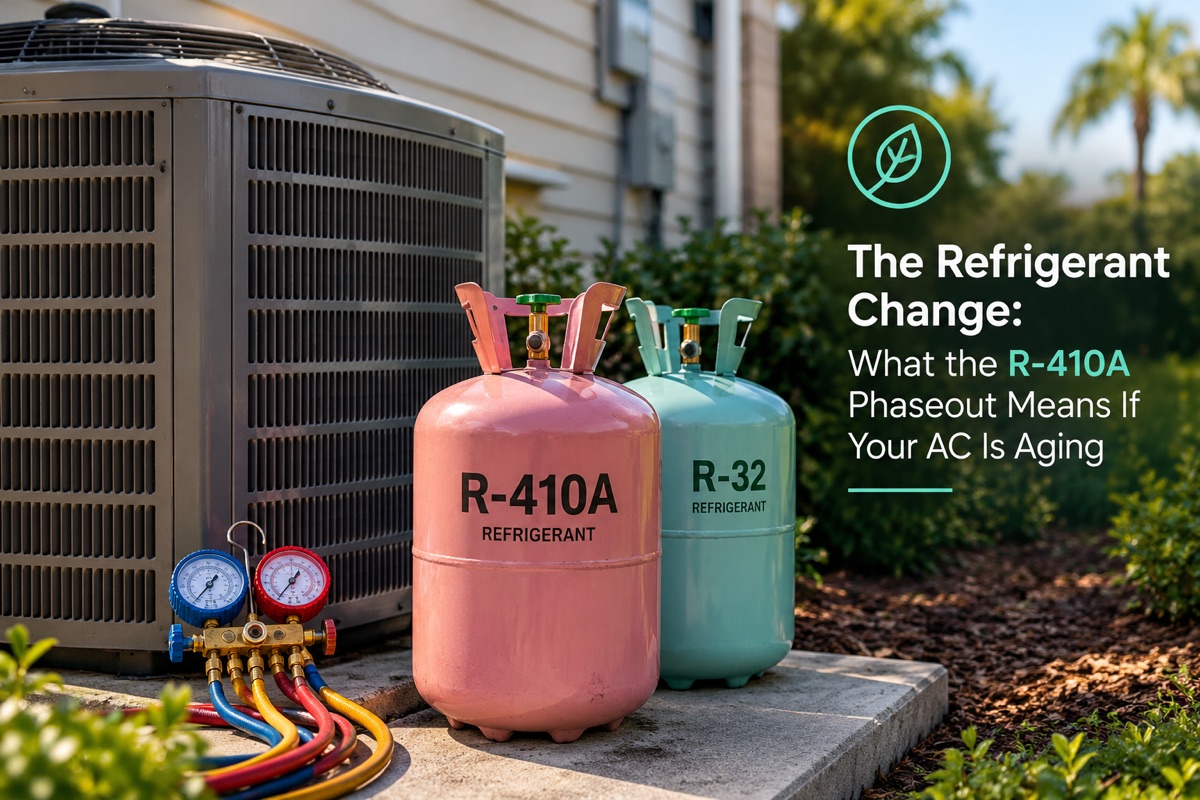
If you’ve gotten an AC repair quote lately and been surprised by the refrigerant line, or if a technician has mentioned “R-454B” or “A2L” and you nodded along, you’re not alone. The air conditioning industry is in the middle of its biggest refrigerant change in more than a decade, and it affects every Jacksonville homeowner with central air.
The short version: your current AC is not illegal, and you don’t have to replace it. But the refrigerant change should factor into your repair-or-replace decisions, especially if your system is getting older. Here’s what’s happening and what it means for you.
Why Refrigerants Are Changing
Refrigerant is the fluid your AC uses to move heat out of your home. Over the decades, the industry has moved through several generations of refrigerants as regulations tightened:
- R-22 (“Freon”) was the standard for decades. Production and import ended in 2020 because it damages the ozone layer.
- R-410A (“Puron”) replaced it and has been in nearly every new residential system for roughly the last 15 years. It doesn’t harm the ozone layer, but it has a high global warming potential (GWP), roughly 2,000 times that of carbon dioxide.
- A2L refrigerants, mainly R-454B and R-32, are the new standard. They have a much lower GWP.
Under the federal AIM Act, the EPA is phasing down production of high-GWP refrigerants like R-410A over time, and it set rules for what new equipment can use.
The Key Dates
- January 1, 2025: Manufacturers could no longer produce or import new residential split-system air conditioners and heat pumps using R-410A. New systems now use A2L refrigerants.
- January 1, 2026 (original deadline, now removed): The EPA originally required leftover pre-2025 R-410A equipment to be installed by this date.
- July 27, 2026: An EPA rule change took effect removing that installation deadline. Contractors can now continue installing R-410A equipment that was manufactured before 2025 until existing inventory runs out.
So you may still be offered an R-410A system for a while. That doesn’t mean it’s the right choice for every home. More on that below.
What This Means If You Have an R-410A System
Most Jacksonville homes with an AC installed between about 2010 and 2024 use R-410A. If that’s you:
- You can keep using it. There’s no requirement to replace a working system.
- It can still be repaired and recharged. R-410A remains available for servicing existing systems, including reclaimed and recycled refrigerant.
- Refrigerant costs are likely to keep rising. As production is reduced under the federal phasedown, R-410A supply tightens and prices tend to go up. A repair that involves a large refrigerant recharge will cost more than it would have a few years ago.
- Replacement parts are still available. Manufacturers can continue making properly labeled R-410A components to repair existing systems.
Not sure which refrigerant you have? Check the data plate on your outdoor unit. It will list the refrigerant type and the system’s manufacture date.
What This Means If You Still Have an R-22 System
If your system is old enough to use R-22, it’s likely 15 to 20+ years old. Because R-22 is no longer produced, the only supply is recovered and reclaimed refrigerant, and it is very expensive. A significant R-22 leak is usually the point where replacement makes more financial sense than repair.
Repair or Replace? How the Refrigerant Change Factors In
The refrigerant change doesn’t automatically mean you should replace your AC. But it shifts the math in a few common situations.
Repair usually makes sense when:
- The system is relatively young (under about 10 years)
- The repair doesn’t involve a major refrigerant loss
- The problem is a single part like a capacitor, contactor, fan motor, or control board
- The system has been reliable and is still under warranty
Replacement deserves a serious look when:
- There’s a refrigerant leak in an older system. A leaking evaporator coil or condenser coil on a 12-to-15-year-old R-410A system can mean paying for an expensive coil and an expensive refrigerant charge, on equipment that’s near the end of its life anyway.
- The compressor has failed on an aging system.
- You’re recharging refrigerant repeatedly. Refrigerant doesn’t get “used up.” If your system needs refrigerant added every year, there’s a leak, and you’re paying for it over and over.
- Repair costs are approaching half the cost of a new system.
- Your system is R-22.
Keep Jacksonville’s climate in mind too. Our systems run hard for most of the year, so a 12-year-old AC here has often seen more runtime than a 12-year-old system up north.
Can I Just Replace the Outdoor Unit?
This is one of the most common questions we get, and with the refrigerant change, the answer matters more than ever.
Your AC system is a matched set: the outdoor condenser, the indoor evaporator coil, and the refrigerant lines between them. A2L systems are designed and rated as complete systems, and their refrigerant isn’t interchangeable with R-410A. You generally can’t put a new A2L outdoor unit on an old R-410A indoor coil.
In most cases, replacing a system today means replacing both the outdoor and indoor components together. Replacing everything at once also gives you the efficiency rating you’re paying for, a matched manufacturer warranty, and a chance to fix airflow or ductwork issues while the system is open.
Should I Choose an R-410A System or an A2L System?
With the installation deadline lifted, some contractors are still offering remaining R-410A inventory, sometimes at a discount. It can be tempting, but consider the trade-offs:
Leftover R-410A system
- May have a lower upfront price
- You’re buying into a refrigerant that will likely cost more to service each year you own it
- Equipment may have been sitting in a warehouse for some time
New A2L system (R-454B or R-32)
- Typically a higher upfront cost
- Uses the refrigerant the industry is moving toward, with better long-term service availability
- Includes the latest efficiency and safety designs
For most homeowners planning to stay in their home for years, an A2L system is the more future-proof choice. If you’re selling soon or working with a tight budget, a remaining R-410A system can be reasonable, as long as you understand what you’re buying.
Are the New Refrigerants Safe?
A2L refrigerants are classified as “mildly flammable,” which understandably raises questions. In practice, they’re very difficult to ignite, and they’ve been used safely in homes in other parts of the world for years.
New A2L systems include safety features such as refrigerant leak sensors that automatically run the blower to disperse refrigerant if a leak is detected. Installation and service require updated equipment, procedures, and technician training. That’s another reason to choose a licensed, EPA-certified contractor who is trained on A2L systems.
How to Avoid Being Upsold (or Undersold)
The refrigerant change has created a lot of confusing messaging, some of it designed to scare homeowners into a sale. Keep these points in mind:
- No one can force you to replace a working R-410A system. Be skeptical of anyone who says your system is “illegal” or “can’t be repaired.”
- Ask for the specifics. What failed, what refrigerant your system uses, how much refrigerant it needs, and what the repair costs versus replacement.
- Ask if there’s a leak. A legitimate recharge should come with a conversation about finding and fixing the leak.
- For replacements, ask for a load calculation. A new system should be properly sized for your home, not just matched to the old one. (Our humidity and comfort guide explains why sizing matters so much in Jacksonville.)
- Get the refrigerant type in writing on any replacement quote, along with the equipment’s manufacture date if it’s an R-410A unit.
Planning Ahead
If your system is 10 or more years old, the best time to plan your next move is before it fails in the middle of a July heat wave. Knowing your refrigerant type, your system’s age, and your options lets you make the decision on your schedule instead of in an emergency.
Also consider whether a heat pump makes sense for your replacement. Many new A2L systems are available as high-efficiency heat pumps, which can lower your energy bills year-round. (See The Magic of Heat Pumps.)
How Copper & Co. Can Help
Copper & Co. helps Jacksonville homeowners make clear, honest decisions about their AC systems:
- Refrigerant leak detection and repair
- Straightforward repair-vs-replace assessments
- New A2L air conditioner and heat pump installation
- Load calculations for properly sized replacements
- Maintenance plans to catch problems before they get expensive
Related reading: What’s Wrong With My AC? Common Air Conditioning Problems and How They’re Fixed and How to Cut Your A/C Costs in Jacksonville as JEA Rates Go Up
Frequently asked questions
Do I have to replace my R-410A air conditioner?
No. There's no requirement to replace a working R-410A system. It can still be repaired and recharged, and replacement parts remain available.
How do I know which refrigerant my AC uses?
Check the data plate on your outdoor unit. It lists the refrigerant type and the system's manufacture date.
Can I replace just the outdoor unit with a new A2L model?
Generally not. A2L systems are designed and rated as complete systems, and their refrigerant isn't interchangeable with R-410A, so a new A2L outdoor unit can't go on an old R-410A indoor coil.
Are A2L refrigerants like R-454B and R-32 safe?
They're classified as mildly flammable but are very difficult to ignite, and they've been used safely in homes elsewhere in the world for years. New A2L systems include refrigerant leak sensors that run the blower to disperse refrigerant if a leak is detected.
Should I buy a leftover R-410A system or a new A2L system?
For most homeowners planning to stay in their home for years, an A2L system is the more future-proof choice. A remaining R-410A system can be reasonable if you're selling soon or on a tight budget, as long as you understand that its refrigerant will likely cost more to service over time.
My AC needs refrigerant added every year. Is that normal?
No. Refrigerant doesn't get used up, so a system that needs recharging repeatedly has a leak. A legitimate recharge should come with a conversation about finding and fixing it.